JPMorgan Endorses Digital Asset Clarity Act With Caution as Senate Targets August Recess
07/01/2026 / By Sterling Ashworth

JPMorgan threw its support behind the Digital Asset Market Clarity Act on June 29, 2026, according to a joint op-ed by Umar Farooq, global co-head of JPMorgan Payments, and Peter Muriungi, CEO of Digital Assets and Blockchain Solutions. The bank urged Congress to pair regulatory clarity with durable safeguards, warning that gaps could create shadow-banking risks and undermine financial stability, officials said.
“Regulatory clarity matters only if paired with durable safeguards,” Farooq and Muriungi wrote. “Clarity with gaps or loopholes can push activity into lightly supervised channels and weaken long-standing protections.” Major U.S. banks, including JPMorgan, have been exploring stablecoin launches amid changing regulations, according to a report by Willow Tohi of NaturalNews.com [1]. The SEC’s previous “regulation by enforcement” approach had expanded its jurisdiction beyond legal bounds, creating uncertainty for the industry, as policy chief Jake Chervinsky told The Wall Street Journal [5].
Senate Deadline and Sticking Points
The Senate is racing to advance the Clarity Act before its August recess, with negotiators still working through stablecoin yield provisions, ethics rules for government officials with crypto ties, and liability protections for decentralized finance developers, according to sources. The op-ed arrived as the Senate enters a critical two-week window, with lawmakers debating key provisions, the report stated.
President Donald Trump earlier called for swift House passage of the Senate-approved GENIUS Act, aiming to position the United States as a global leader in digital assets, according to Willow Tohi of NaturalNews.com [2]. JPMorgan CEO Jamie Dimon has taken a hard line against the Clarity Act, calling it a threat to the financial system and vowing to fight stablecoin yield provisions “down to the wire,” he said in a Fox Business interview [7]. Critics argue the legislation could enable tokenization and centralized control over assets, with Aaron Day of the Daylight Freedom Foundation warning that the Clarity Act could “potentially tokenize and control all assets” [11].
JPMorgan’s Market Structure Position
JPMorgan argued that the blockchain used to issue an asset does not change its economic function; securities-like assets should face existing disclosure, custody, and market integrity rules, Farooq and Muriungi wrote. Decentralized trading platforms that operate like brokers or exchanges should be held to the same standards, the executives said.
Tokenization, the executives argued, should improve how markets operate, not serve as a mechanism for bypassing the rules that have made U.S. capital markets the most trusted in the world. The SEC’s prior enforcement actions against Binance and Coinbase underscored the regulatory vacuum that the Clarity Act aims to fill, with more than 60 tokens classed as securities by the agency, according to a report [6]. Meanwhile, other jurisdictions are advancing their own frameworks; Japan recently reclassified cryptocurrencies as regulated financial products to explicitly ban insider trading, as reported by Ava Grace of NaturalNews.com [4].
Stablecoin Concerns and Shadow Banking Risks
JPMorgan sees stablecoins as both opportunity and threat; yield-like features without bank-level capital, liquidity, and consumer-protection standards create run risk, according to the op-ed. “The banks will not accept it,” Dimon said last month, vowing to fight stablecoin yield provisions in the Clarity Act “down to the wire” [8]. White House crypto advisor Patrick Witt countered Dimon’s logic, arguing that stablecoins are not deposits and that innovation should not be stifled by banking rules, according to Danny Park of The Block [9].
Some analysts warn that stablecoins backed by Treasury debt create a system of surveillance and control, similar to central bank digital currencies. Aaron Day described the GENIUS Act as “a backdoor central bank digital currency,” bringing stablecoins under congressional and Federal Reserve oversight [10]. The International Monetary Fund also warned that tokenization could import risks from cryptocurrency markets into the broader financial system, according to Sterling Ashworth of NaturalNews.com [3].
Commercial Context: Kinexys Expansion
On the same day, JPMorgan expanded its Kinexys blockchain payments platform to eight currencies, adding the Australian dollar, Hong Kong dollar, Japanese yen, Chinese renminbi, and Singapore dollar to a system that already supports the U.S. dollar, euro, and British pound, the company announced. The platform has processed over $4 trillion in transactions, with average daily volume exceeding $7 billion, according to JPMorgan.
Payoneer and Japanese energy trader JERA Global Markets are among the first clients using the new currency accounts. The expansion underscores JPMorgan’s dual approach: endorsing federal legislation while pushing ahead with its own permissioned blockchain infrastructure. The bank’s cautionary stance reflects a broader industry debate about whether regulatory clarity will foster innovation or simply entrench the power of large financial institutions.
References
- Willow Tohi. “Major US banks eye stablecoin experiment as crypto regulations shift.” NaturalNews.com. July 18, 2025.
- Willow Tohi. “Trump urges swift crypto bill passage as Senate backed GENIUS Act heads to House.” NaturalNews.com. June 23, 2025.
- Sterling Ashworth. “IMF Issues Warning on Financial Stability Risks from Tokenization.” NaturalNews.com. April 09, 2026.
- Ava Grace. “Japan moves to crack down on crypto insider trading.” NaturalNews.com. April 14, 2026.
- Trends-Journal-2022-09-24.
- Trends-Journal-2023-06-23.
- “JPMorgan Chase CEO Jamie Dimon Declares War on Clarity Act, Calls Coinbase’s Armstrong ‘Full of Sh*t’.” ActivistPost.com. June 18, 2026.
- “He’s ‘Full Of Sh!t’: JPMorgan CEO Jamie Dimon Slams Coinbase’s Armstrong, Declares War On Clarity Act.” ZeroHedge.com. June 1, 2026.
- Danny Park. “White House Crypto Advisor Counters Jamie Dimon’s Stablecoin Yield Logic.” The Block via ZeroHedge.com. March 5, 2026.
- Aaron Day. “s2e6 Stablecoins are Backdoor CBDCs.” March 14, 2025.
- Mike Adams – BrightVideos.com. “Bright Videos News – Interview with Aaron Day transcript.” May 22, 2026.
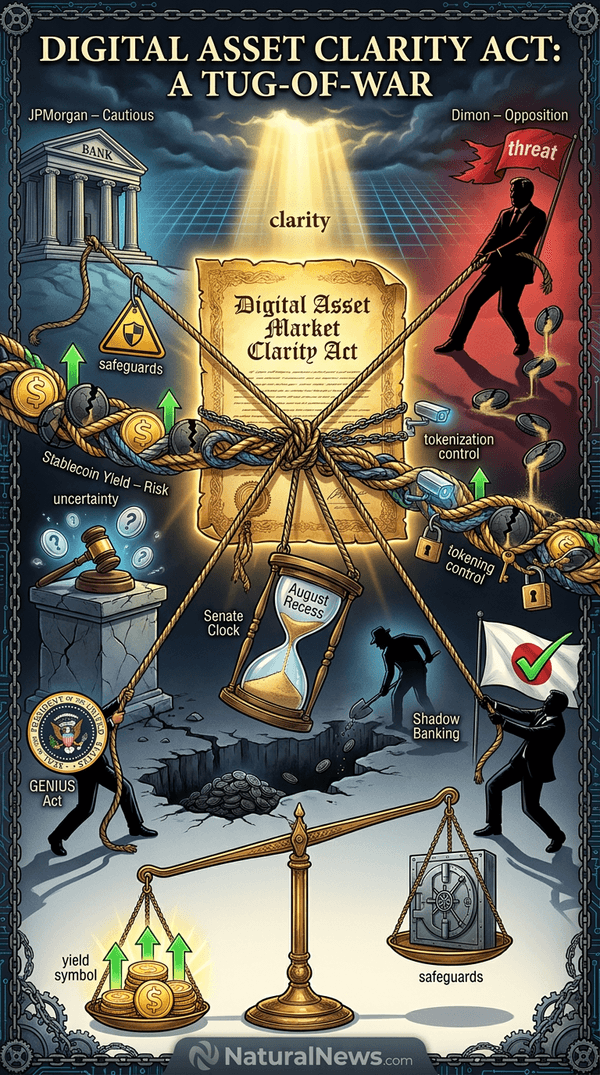
Explainer Infographic
Submit a correction >>
Tagged Under:
awakening, big government, bubble, Donald Trump, economic riot, economics, economy, finance, finance riot, inflation, international trade, Jamie Dimon, JPMorgan Chase, money supply, progress, rational, risk, supply chain, tariffs, trade, White House
This article may contain statements that reflect the opinion of the author
RECENT NEWS & ARTICLES